Cyan Eyed features a air ship, that on first glance reminded by of the The Jenny Haniver, but on further inspection I noticed this vessel is a lot larger. Also, there was a robot or should I say a flying mech unit. A great short film by Dust.
Showing posts with label airships. Show all posts
Showing posts with label airships. Show all posts
Saturday, March 4, 2023

Friday, February 11, 2022
Airship Over London

Screenshot from Sherlock Holmes
The airship is propelled by rotor blades above and below the airship. There is a small repeating gun installed for offensive and defensive maneuvers.
This isn't your average Sherlock Holmes story. This video includes autimated rubber dinosaurs and a Kraken. The movie stars Dominic Keating and Gareth David-Lloyd.
Friday, February 4, 2022
The Making of the Jenny Haniver

Mortal Engines, Universal Pictures, November 27, 2018, The Jenny Haniver
I viewed Mortal Engines sometime ago and had forgotten all about the Jenny Haniver until I came across this short video on the making of the Jenny Haniver. Like most movie sets a minature version of the prop is typically created before making the full sized one.
The video doesn't contain too much in the way of the actual construction of the Jenny Haniver, but it does show both versions, the miniature during different phases of construction and the full life-like version during filming.
Friday, November 19, 2021
Strange Ships that Sail in the Skies

Here is a link back to Voyages Extraordinaries and a artilce they republished on their site "Strange Ships that Sail in the Skies". The article is reprint of a 1897 article that purported many fanicful and may I add whimsical "flying-machines".
Thursday, July 8, 2021
Airships, Ether flyers, and Flying Machines

Over the years I have made a few posts under the airship and ether flyers labels. However Voyages Extraodinaires has posted so many of these types of posts under their Flying Machines label. It is an extraordinary collection of references to bygone movies, vintage publications and yes, Flying Michines.
Wednesday, April 15, 2020
Daniel Agdag’s Whimsical Sculptures
Here is another inspirational page that features whimsical structures and airships that were created only from cardboard. These sculptures are simply wonderful and inspiring. Just imagine what can be created from simple and readily available materials.
Friday, February 14, 2020
Mortal Engines

Table of Contents
Part 1
-
The Hunting Ground
-
Valentine
-
The Waste Chute
-
The Out-Country
-
The Lord Major
-
Speedwell
-
High London
-
The Trading Cluster
-
The Jenny Haniver
-
The 13th Floor Elevator
-
Airhaven
-
The Gasbag and Gondola
-
The Resurrected Man
-
The Guildhall
-
The Rustwater Marshes
-
The Turd Tanks
-
The Pirate Suburb
-
Bevis
-
The Sea of Khazak
-
The Black Island
-
In the Engineerium
-
Shrike
-
MEDUSA
Part 2
-
An Agent of the League
-
The Historians
-
Batmunker Gonpa
-
Dr. Arkengarth Remembers
-
A Stranger in the Morentains of Heaven
-
Going Home
-
The Eavesdropper
-
Chudleigh Pomeroy Sees It Through
-
Wine and Nibbles and the Dawn of a New Era
-
Idea for a Firework Display
-
The Cathedral
-
The Shadow of Bones
-
The Bird Roads

An alternative cover and edition
Other Links
Wednesday, February 12, 2020
The Jenny Haniver

Mortal Engines, Universal Pictures, November 27, 2018
"The Jenny Haniver was no elegant sky-clipper, but was in fact a culmination of bits of junk scavenged from junk yards. “There was an envelope of silicon silk from a Shan Guo clipper, twin Jeunet Carot areo engines off a Paris gunship, the reinforced gas-cells of a Spitzbergen war-balloon, it is amazing what one can find at a junkyard”.
Mortal Engines, book 1, Philip Reeve
Friday, April 26, 2019
Steam Punk Airships Extraordinaire
These steampunk airships were created mostly from cardboard and are extraordinary...
Thursday, May 18, 2017
Strange Phenomena

By Warren, Ambrose William, 1781?-1856, engraver. [Public domain],
via Wikimedia Commons

This another quote from Wells alternate historty novel The War in the Air.
"And that was only the beginning of a succession of strange phenomena in the heavens—cylinders, cones, pear-shaped monsters, even at last a thing of aluminium that glittered wonderfully."
The War in the Air, H. G. Wells
Thursday, May 11, 2017
The Attack on New York City
This is another post to my alternative history series, a series that I have neglected for some time. The Battle of Dorking, an interesting back-story to a board game by the same name that portrays an alternative historical event needs posting.
“The City of New York was in the year of the German attack the largest, richest, in many respects the most splendid, and in some, the wickedest city the world had ever seen. She was the supreme type of the City of the Scientific Commercial Age; she displayed its greatness, its power, its ruthless anarchic enterprise, and its social disorganization most strikingly and completely. She had long ousted London from her pride of place as the modern Babylon, she was the center of the world’s finance, the world’s trade, and the world’s pleasure; and men likened her to the apocalyptic cities of the ancient prophets. She sat drinking up the wealth of a continent as Rome once drank the wealth of the Mediterranean and Babylon the wealth of the east. In her streets one found the extremes of magnificence and misery, of civilization and disorder. In one quarter, palaces of marble, laced and, crowned with light and flame and flowers, towered up into her marvelous twilight beautiful, beyond description; in another, a black and sinister polyglot population sweltered in indescribable congestion in warrens, and excavations beyond the power and knowledge of government. Her vice, her crime, her law alike were inspired by a fierce and terrible energy, and like the great cities of medieval Italy, her ways were dark and adventurous with private war.”
Chapter VI, How War Came To New York. The War in the Air, H. G. Wells
Tuesday, May 2, 2017
A Han Ship
"This ship was not unlike the great dirigibles of the Twentieth Century in shape, except that it had no suspended control car nor gondolas, no propellers, and no rudders, aside from a permanently fixed double-fishtail stabilizer at the rear, and a number of "keels" so arranged as to make the most of the repeller ray airlift columns.
Its width was probably twice as great as its depth, and its length about twice its width. That is to say, it was about 100 feet from the main keel to the top-deck at their maximum distance from each other, about 200 feet wide amidship, and between 400 and 500 feet long. It had in addition to the top-deck, three interior decks. In its general curvature the ship was a compromise between a true streamline design and a flattened cylinder.
For a distance of probably 75 to 100 feet back of the nose there were no decks except that formed by the bottom of the hull. But from this point back the decks ran to within a few feet of the stern.
At various spots on the hull curvature in this great "hollow nose" were platforms from which the crews of the dis ray generators and the electronoscope and electronophone devices manipulated their apparatus.
Into this space from the forward end of the center deck, projected the control room. The walls, ceiling and floor of this compartment were simply the surfaces of viewplates. There were no windows or other openings."
The Airlords of Han, by Philip Francis Nowlan
Thursday, March 30, 2017
The Wind Whales of Ishmael
“One man survived.
The great white whale with its strange passenger and the strangled monomaniac its trailer, had dived deeply. The whaling ship was on its last, its vertical, voyage.”

This will be my fifth book in the Wold Newton Universe series that I have read. Like the rest of Farmer's work, it is hard to put this one down. This volume is a sequel to Melville’s Moby Dick in a way that only Farmer could come up with.
Thursday, December 4, 2014
Giant Conger Eels
“The four adventurers had just quite the Flying Fish and were walking toward an ancient grass-grown wreck when they became startled by the appearance of a snake like head and a pair of fierce gleaming eyes that had, quite suddenly protruded from a gap in the ships side.
Within moments the conger eel, with truly gigantic proportions, emerged from its hiding place and was slithering, boldly toward the four adventures. This wasn't the only conger eel to do so, thus attracted by the strong light from the Flying Fish forty or so eels, some up to 18 feet long came fiercely towards the four almost over whelming the four.”
The Log of the Flying Fish, Harry Collingwood
Tuesday, November 4, 2014
Airships
Dirigible Airships Compared
with
Related Aerostats
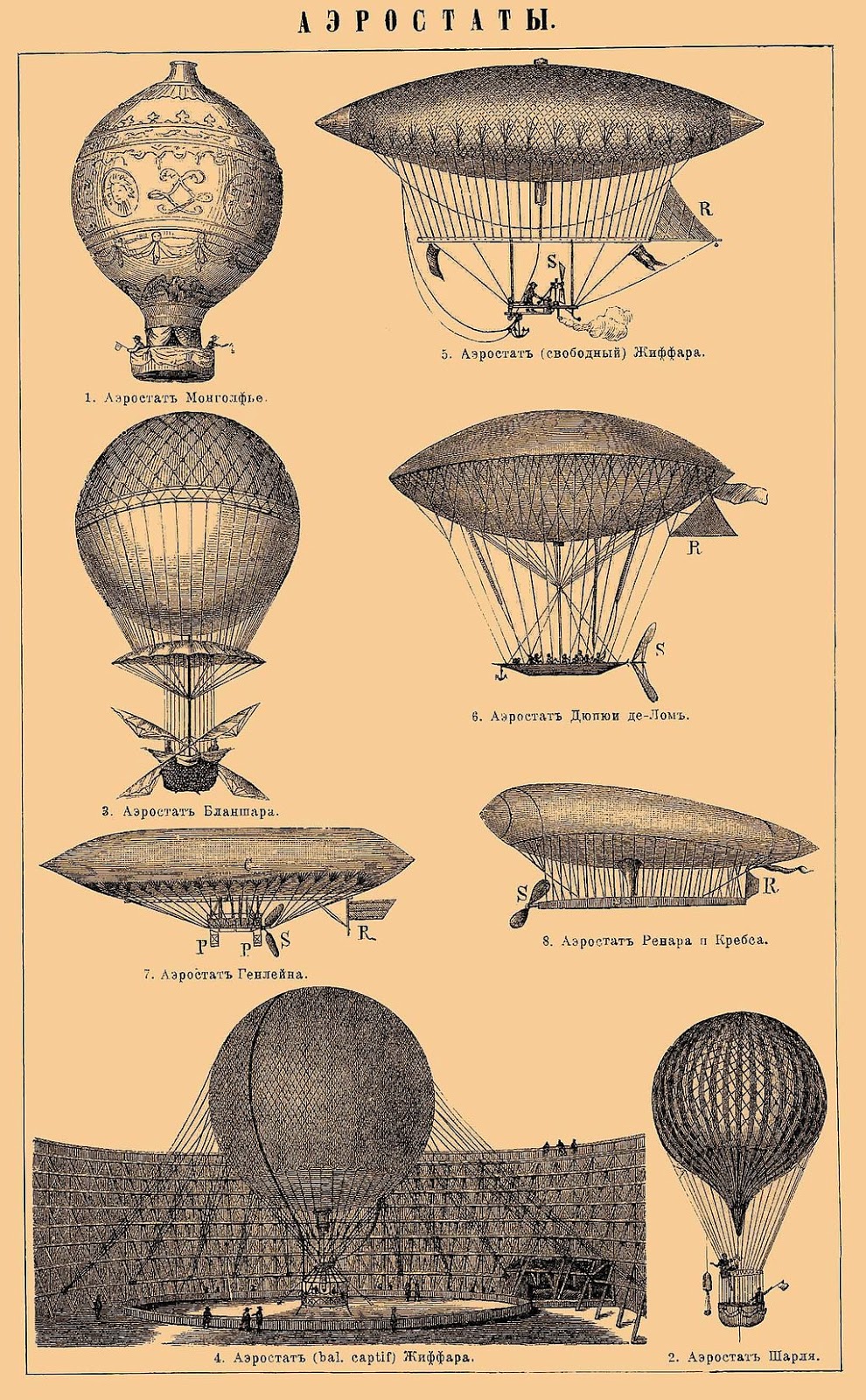
From a turn of the 20th century encyclopedia.
See page for author [Public domain], via Wikimedia Commons
![See page for author [Public domain], via Wikimedia Commons](http://commons.wikimedia.org/wiki/File%3ABrockhaus-Efron_Aeronavtika.jpg)
It has been a while since I posted anything labeled “Airships”.
I was looking through Games Vault’s online war games offerings and found an Avalon
Games expansion set for their Land Ships mini game. I put the game on my Wish
List and I will be ordering this expansion along with later very soon. At any
rate, that got me thinking about airships. A quick search brought up several
airship hits including the “Dirigible Airships” illustration and the following “TheAirship and Futurism: Utopian Visions of the Airship” article, published by Airships.net.
Tuesday, July 22, 2014
Cloudship Atlantis RPG

Cloudship Atlantis is a Steampunk Role Playing Game
Atlantis is Victorian city that floats above a barren wasteland called Terra Firma. There are two classes living on the Cloudship Atlantis, the Humbles and the Gentry. The Humbles are born into servitude. The Humbles are born and live below in the bow of the airship, and they work stoking the fire of the boiler and servicing the boiler, the Humbles mine coal, and make sure that they keep Atlantis’s air sacks inflated. The Gentry live in luxury above the bow where the air blows cool. “Gentry are tall, educated and haughty. Appearance, decorum and social status is all important.”
You and a fellow Humble escape from the bows of the cloud ship. Perhaps it was done on a whim, or because of a wager. Perhaps you just wanted to see and experience how the other half lives. At any rate you make it above the desks and now you need to ensure that you stay there.
The Cloudship Atlantis RPG was written by Dr. Robert Lang, back in 2009 for the RPG’s Blog 24 hour Competition.
Saturday, May 24, 2014
Specifications of the Albatross
The Albatross is said to be able to run at speeds up to 120 MPH; this not to say how fast the craft could travel with a good wind at her back. Other specifications of the Albatross are directly from Verne’s Rubur the Conqueror.
“Platform—This was a framework a hundred feet long and twelve wide, a ship's deck in fact, with a projecting prow. Beneath was a hull solidly built, enclosing the engines, stores, and provisions of all sorts, including the water tanks. Round the deck a few light uprights supported a wire trellis that did duty for bulwarks. On the deck were three houses, whose compartments were used as cabins for the crew, or as machine rooms. In the center house was the machine which drove the suspensory helices, in that forward was the machine that drove the bow screw, in that aft was the machine that drove the stern screw. In the bow were the cook's galley and the crew's quarters; in the stern were several cabins, including that of the engineer, the saloon, and above them all a glass house in which stood the helmsman, who steered the vessel by means of a powerful rudder. All these cabins were lighted by port-holes filled with toughened glass, which has ten times the resistance of ordinary glass. Beneath the hull was a system of flexible springs to ease off the concussion when it became advisable to land.
Engines of Suspension and Propulsion—Above the deck rose thirty-seven vertical axes, fifteen along each side, and seven, more elevated, in the center. The "Albatross" might be called a clipper with thirty-seven masts. But these masts instead of sails bore each two horizontal screws, not very large in spread or diameter, but driven at prodigious speed. Each of these axes had its own movement independent of the rest, and each alternate one spun round in a different direction from the others, so as to avoid any tendency to gyration. Hence the screws as they rose on the vertical column of air retained their equilibrium by their horizontal resistance. Consequently the apparatus was furnished with seventy-four suspensory screws, whose three branches were connected by a metallic circle which economized their motive force. In front and behind, mounted on horizontal axes, were two propelling screws, each with four arms. These screws were of much larger diameter than the suspensory ones, but could be worked at quite their speed. In fact, the vessel combined the systems of Cossus, La Landelle, and Ponton d'Amécourt, as perfected by Robur. But it was in the choice and application of his motive force that he could claim to be an inventor.
Machinery—Robur had not availed himself of the vapor of water or other liquids, nor compressed air and other mechanical motion. He employed electricity, that agent which one day will be the soul of the industrial world. But he required no electro-motor to produce it. All he trusted to was piles and accumulators. What were the elements of these piles, and what were the acids he used, Robur only knew. And the construction of the accumulators was kept equally secret. Of what were their positive and negative plates? None can say. The engineer took good care—and not unreasonably—to keep his secret unpatented. One thing was unmistakable, and that was that the piles were of extraordinary strength; and the accumulators left those of Faure-Sellon-Volckmar very far behind in yielding currents whose ampères ran into figures up to then unknown. Thus there was obtained a power to drive the screws and communicate a suspending and propelling force in excess of all his requirements under any circumstances.”
Rubur the Conquerer, Chapter 7 On Board The Albatross, Jules Verne
Quote from Rubur the Conquerer

Image was found here and is in the public domain.

“Honorable balloonists”, Rubur said in a serious tone. “You are free to come and go as you like.”
“Free!” exclaimed Uncle Prudent.
“Yes-within the limits of the Albotross!” By this time they were about four-thousand feet above the earth.
Quote from Rubur the Conquerer
Wednesday, May 14, 2014
Jules Verne’s Voyages Extraordinaires that Have a Sequel
As far as my readings of Jules Verne have taken me these are the only sets of sequels that I know of. I would be happy to find out otherwise…
Twenty Thousand Leagues under the SeaMysterious Island
These tales include the mention of Captain Nemo and his Nautilus submarine.
Robur the ConquerorThe Master of the World
These tales are about embittered engineers and their airships. I found The Master of the World better reading than Robur the Conqueror. Robur the Conqueror really didn’t have too much of a plot.
Tuesday, May 6, 2014
Learning to Fly

The image of Leonardo da Vinci’s helicopter was found on Wikipedia and is in the public domain.
“When will man cease to crawl in the depths to live in the azure and quiet of the sky?”, Camille Falmmarion
According to Verne in his “Rubur the Conquerer” one of the following three modes must be employed in order to produce flight:
- Helicopters or spiralifers which are simply screws with a vertical axis
- Ornithopters, which are machines which endeavor to, reproduce the natural flights of birds
- Aeroplanes, which are merely inclined planes like kites, but are towed or driven by screws
Rubur the Conquerer, Jules Verne
Which of the modes did Rubur emulate for his airship the Albatross? Although it is said that Rubur abhorred the first two approaches, the description of the Albatross does make it seem more like the helicopter than an aeroplane.
Subscribe to:
Posts (Atom)