Showing posts with label Roc. Show all posts

Wednesday, December 29, 2021

You Can Still Find Rocs on Margrave

“I had been sent to Margrave, a world in the first stages of colonization. I was twenty minutes out of Triangle Lake and on my way to the Wiggly River logging region flying at an attitude of thousand feet. It seems the equipment needed some adjustments. The system had been harvesting trees that were too young and I was sent to investigate and to make changes to the program settings.

I was in the back seat of my transport when the roc swept down on me, wrapped ten huge talons around my transport and swallowed it. Everything went black and the transport flew blithely on, ignoring the roc. The ride became turbulent when the roc tried to fly away and couldn’t.

I tried the radio and got nothing. Either it couldn’t reach out beyond all that meat around me, or my antennas had been broken off while making the way down the rocs gullet. As the roc settled down on a ledge, there didn’t seem to be anything I could do. I knew that the power would last for some time as long as I used it sparingly and I had an emergency food maker and other supplies, so I just hunkered down and waited for the roc to decompose. It took six months for enough of the roc to decompose to allow me to squeeze out between a couple of the rocs ribs.”

Safe at any Speed, Tales of Known Space, Larry Niven

Thursday, April 23, 2020

The Great Eagle Salutation

Image from The Hobbit an Unexpected Journey

Whether Tolkien was thinking about the Roc when he wrote the Hobbit Tolkien referred to his creatures’ great eagles.

’Farewell wherever you fare, till your eyries receive you at journey’s end!’

‘May the wind under your wings bear you where the sun sails and the moon walks’

The Hobbit, J. R. R. Tolkien

Wednesday, March 23, 2016

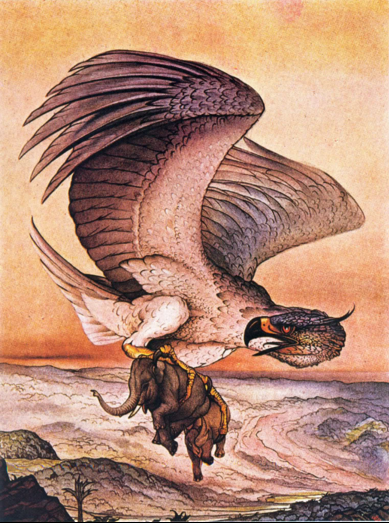
The Mystical Roc


The original full sized Wikipedia image can be found here

The Roc creature was mentioned within the text of Sinbad the Sailor and was accepted by Europeans throughout the 16th century as being a genuine creature. Although today the creature is thought as  a mystical creature and the stuff of legends. However, In 1604 Michael Drayton wrote a rather fanciful poem envisaging the roc being taken aboard the Ark:

All feathered things yet ever knowne to men,
From the huge Rucke, unto the little Wren;
From Forrest, Fields, from Rivers and from Pons,
All that have webs, or cloven-footed ones;
To the Grand Arke, together friendly came,
Whose severall species were too long to name.


Another ROC resource

Wednesday, August 19, 2015

Diamonds, Giant Snakes and the Roc

On Sinbad's second voyage he was once again shipwrecked. On this occasion he wound up on an island that could not sustain life and he looked for a way to escape from his predicament. While he was investigating the island he came upon a large circular object “that was at least fifty paces round.”

While investigating the object Sinbad noticed a huge black cloud hovering overhead and he remembered hearing sailors tell of a wonderful bird called a Roc. The Roc is a mythological bird of huge proportions and object that Sinbad was investigating was obviously a Roc egg.

“Sure enough the bird settled slowly down upon it, covering it with its wings to keep it warm, and I cowered close beside the egg in such a position that one of the bird's feet, which was as large as the trunk of a tree, was just in front of me. Taking off my turban I bound myself securely to it with the linen in the hope that the roc, when it took flight next morning, would bear me away with it from the desolate island.”

The next morning, the roc left its nest and flew off to an distant island and upon touching ground Sinbad released himself from  the bird and ” as I wandered about, seeking anxiously for some means of escaping from this trap, I observed that the ground was strewed with diamonds, some of them of an astonishing size. This sight gave me great pleasure, but my delight was speedily damped when I saw also numbers of horrible snakes so long and so large that the smallest of them could have swallowed an elephant with ease.” 

Sinbad the Sailor’s Second Journey