Showing posts with label The Complete Book of Dragons. Show all posts

Friday, October 9, 2015

Other Species of Dragons

Although this will not be my last post on dragons, this is will probably be my last post made under The Complete Book of Dragons tag. Other than the dragons that I have already made posts there are three other species of dragons that are mentioned in this wonderful book. The three other species are the Wyvern, Amphithere, and the Marsupial dragons.

Wyvern

Unlike other dragons the wyvern only has two legs. The wyvern is the largest form of dragon and is sufficiently large enough to carry away a large elephant in its claws. Adult wyvern’s can grow up to fifty feet long and up to twenty feet high. There coloration is anywhere from a muddy brown to a lime green. The wyvern will make its lair or nest in a rocky crag or in some occasions in a circular nest in sand dunes or grass lands. The wyverns were once found throughout the African continent and the Middle East.

Amphithere

There are two types of amphithere. The Mexican feathered and a furry North American amphithere. The amphithere is a fire breather and once was found along the west coasts of North and South America. The amphithere dragon can grow up to forty-five feet long and between five and ten feet high. They will nest or build their lairs among the reeds on lakeside of offshore islands.

Marsupial

The marsupial dragon is largely confined to southeastern Australia and can reach sizes up to twenty-five feet long and between fifteen and eighteen feet high. The text mentions that the marsupial dragon breathes blue smoke and does start brush fires to thrush out its prey. Its coloration is anywhere from a green to a greenish blue. The marsupial dragon, like other marsupials, carry their young in their pouch.

Saturday, February 21, 2015

Eastern Dragons: Chinese Lung

The Chinese Lung has many of the same characteristics as the Asian Lung. Here are some of its more prominent features:

  • Long, whiskery feelers
  • Stag like horns
  • Mane
  • Five toes on each claw
  • Large scales
  • Feathery tail
  • Fire breather
  • Females carry their egg, usually in its fore claw

Monday, February 16, 2015

Eastern Dragons: Asian Lung

The Asian Lung can be found in Eastern China and throughout South East Asia. The Asian Lung can also be found in the coastal regions of NE Australia. These dragons are most often found near rivers, streams and lakes were they like to hide there lairs in underwater caves or grotto’s.

The Asian Lung can reach sizes between 12 and 15 feet high and up to 40 feet long. They are similar in appearance to the Tibetan dragon in that they sport a set of whiskers and a set of horns on the top of their heads. The Asian Lung also has four feet, but depending on the subspecies may have four or five toes on each foot.

The Asian Lung can be found in the following coloration: black, blue, white, red or yellow. And like the Chinese Lung the females carry their eggs for safety's sake. These eggs have often been mistaken for huge pearls.

Wednesday, February 11, 2015

Eastern Dragons-Lindworms

Lindworms can be found on the empty steppes of central Asia. Lindworms can grow up to 30 feet long and up to 8 and 10 feet tall. The Lindworm has two feet towards the top of its body, and a set of scales that runs down the middle of its slender body from its head terminating to an arrow head shaped and pointed tail. Lindworms are often found in shades of green, pale orange or a sandy yellow.

Monday, February 9, 2015

Eastern Dragons: Tibetan Dragon

There are four distinct species of eastern dragons; they are the Tibetan, Lindworms, Asian Lung, and the Chinese Lung. The first I will be reporting on is the Tibetan Dragon.

The Tibetan Dragon was found in higher elevations of central Asia. The Tibetan Dragons are mostly red in color and can grow up to ten to twelve feet high and up to forty feet long. They are long slender creatures with scales running down the length of their backs. They have four feet and with five toes. Each toe includes a razor sharp claw. They have what seems like whiskers around their mouths and sport a set of horns on the top of their heads. Their main pray is the Himalayan Yeti a large ape like creature that also abides in higher elevations of the Himalayan Mountains.

“After all, the strangest and maddest of myths are often merely symbols or allegories based upon truth.”

H.P. Lovecraft's The Shadow Over Innsmouth

Blogger’s web editor can be quirky at times. In order to have consistent look I have taken the original post down and have hand-coded the post.

Friday, November 14, 2014

Western Dragons: The Frost Dragon

The Frost Dragon range from the Arctic to Antarctica, the frost dragon fly’s thousands of miles in their migration to and from these regions. They create their lair or nests in caves facing the sea or in hollowed out glaciers or icebergs. The Frost dragon and grow up to 40 feet in length and up to 12 to 14 feet high.

The Frost Dragon has many of the same characteristics as its European cousin and can be found in the following colorization's: pure white, white tinged with blue or pink.

Thursday, November 13, 2014

Western Dragons: The Knucker

The Knucker is another species of dragon that can found in Western Europe. The Knucker can grow up to 30 feet long by 3 to 6 feet high and is serpentine in appearance and like some serpents; it kills by injecting venom in to its victim. The Knucker has two vestigial wings, but cannot fly.

Knuckers can be found in damp woodland locations and make their homes in deep ponds or wells. You can imagine the horror of going out to your well and seeing a Knucker slithering up and out of your well.

Wednesday, November 12, 2014

Western Dragons: The European Dragon

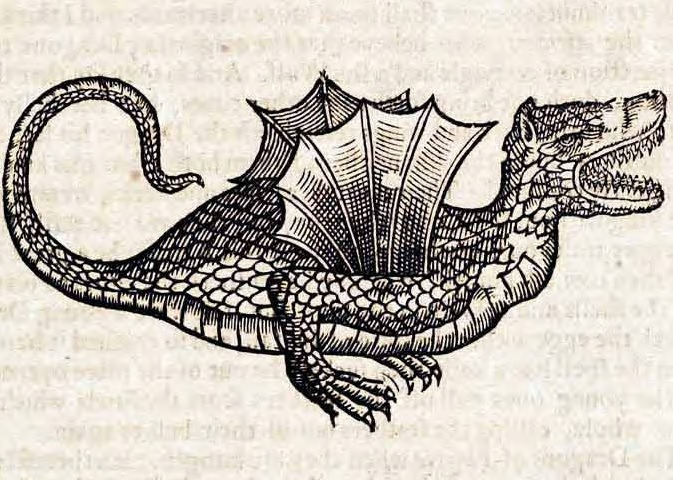
Illustration of a winged dragon from a 1658 edition of Edward Topsell's The History of Four-footed Beasts and Serpents.
Wikipedia-Commons


The European Dragon is the dragon that is commonly thought of when someone talks of Dragons. You know the flying and fire-breathing sort of dragon. This type of dragon is the stuff of legends and folklore. 

The European Dragon’s former range was throughout Western Europe. It commonly made its lair or nest in mountain or sea caves in remote regions.

The European Dragon could grow up to 45 feet long and 13 to 17 feet high. It was one of largest and one of the most feared of all species. This species of dragon could red, green, black, or sometimes gold. It had two great bat-like wings and did breathe fire. This attribute worked well for destroying its enemies as well as roasting its food.

This species only mated every few years and would fly great distances to attract and lure prospective suitors by leaving their spore and markings at intervals along the path toward their lairs.

Other prominent characteristics of the European Dragon are:

  • Arrowhead tail
  • Thick spines
  • Clawed talons
  • Scales
  • Horns
  • Fanged teeth
  • Large eyes that offered phenomenal sight.

As you can imagine; seeing a dragon with these attributes would put the fear into anyone. Yet there were those who for financial gain or just for the glory of it would attempt to slay the mighty dragon. See the story of Beowulf for instance. 

Monday, November 10, 2014

Dragons by Location

The Complete Book of Dragons lists several dragon species by location. Dragons are said to have lived in many different locations and habits around the world. The following species are mentioned by location.

Western

European
Kucker
Frost

Eastern

Tibetan
Lindworms
Asian Lung
Chinese Lung

In addition to those mentioned there were other species which included:

  • Wyvern-middle east and Africa
  • Amphithere-Western North and South America
  • Marsupial-Southern Australia, Tasmania, and New Zealand
I will be making posts on each of the dragons in upcoming posts.

Monday, October 13, 2014

Dragons by Habitat

According to the Complete Book on Dragonology, at one time there existed ten unique dragons that lived in the following habitats:

Forest
Knucker
Marsupial Dragon

Prairie & Steppe
American Amphithere
Lindworm

Desert & Savanna
Wyvern

Mountain
European Dragon
Asian Lung
Tibetan Dragon

Arctic Regions
Frost Dragon

Jungle
Mexican Amphithere

Saturday, October 11, 2014

Dragonology: The Complete Book of Dragons

The Dragonology: The Complete Book of Dragons book measures 10.25 wide by 12 high. Inside its covers you will find color images and illustrations, fold out booklets, notes and other adjunct elements. The book also includes touch and feel samples of “dragon skin”, packets of “magic dust” and other supplementary materials.

Although you cannot take all that is presented seriously, it was a fun book to look through and read. I will be sharing a few of my findings in upcoming posts.